
IRC M1502 Certified • HEPA Decontamination

The cure for clogged, dangerous dryer vents.

Every year, 2,900+ U.S. home dryer fires start in a vent nobody inspected. We measure the airflow you actually have, extract the combustible lint, and rebuild your exhaust path to IRC Section M1502 engineering standards.

Licensed & Insured Same-Day Dispatch CFM Certified Report
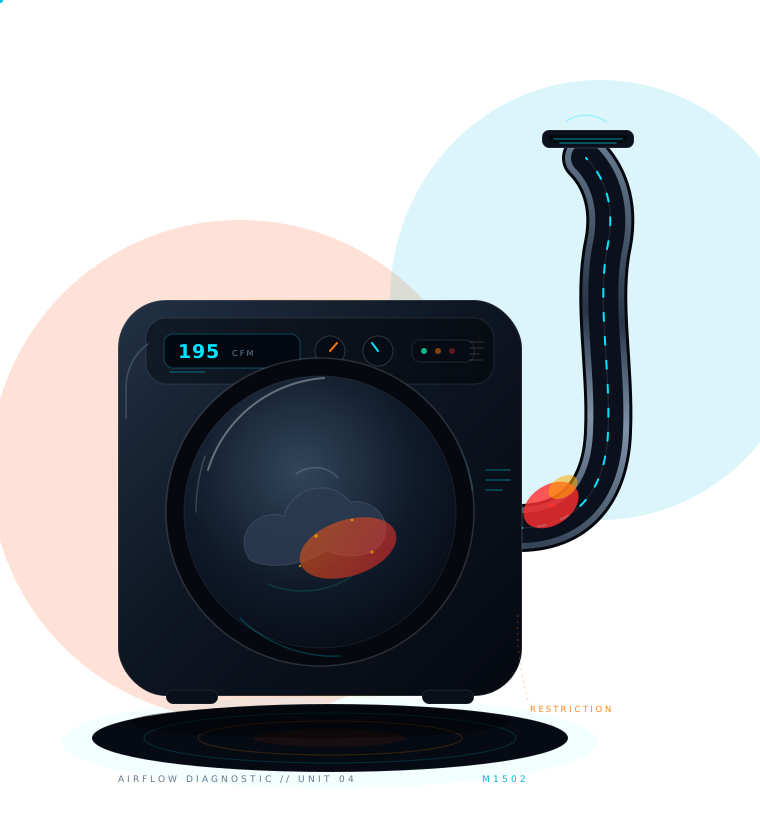
Cutaway technical illustration of a dryer with lint obstruction and exhaust duct airflow
Critical Restriction
35 CFM
195°F thermal 90m dry
Certified Laminar Flow
195 CFM
125°F temp 38m dry
U.S. Fires / Year
2,900+

Residential clothes dryer fires reported annually.

Lint-Caused
34%

Directly ignited by trapped, combustible lint.

Drying Speed
50%+

Faster cycle times after certified airflow restoration.

Code Compliance
100%

Post-service verification against IRC M1502.

Burning smell on laundry day Two cycles to dry one load Hot dryer cabinet or laundry room Lint visible at exterior damper Clothes damp after 90 minutes Crushed accordion transition hose Dryer shutting off mid-cycle Excess humidity & fogged windows
02 — Interactive risk model

Model your vent's failure curve.

Five variables decide how hard your dryer has to fight for airflow. Adjust them below for a live combustible-risk estimate, energy penalty, and code-path recommendation.

Vent Parameters

Digital twin inputs

Live
15 ft
5 ft50 ft
1 turn
05
4 loads
115+
1.5 yrs
0.55+

Duct exit type

Est. model · 4" duct baseline

Combustible Risk Index

NFPA-informed heuristic

Model v2.4
Combustible risk gauge
Risk Score
0 /100
Optimal Est. 195 CFM at termination
Airflow Loss
0%
Energy Penalty
$0/yr
Added Dry Time
+0min
Backpressure
0.0 in. w.g.

Airflow appears within spec.

Schedule an annual verification to keep your vent inside the IRC M1502 envelope.

Book this diagnostic

Model output is a screening estimate, not a combustion diagnosis. On-site anemometer and static-pressure testing determine the certified result.

03 — Airflow chamber comparison

Same wall. Different physics.

Drag the glass divider to expose what 95% lint saturation does to a vent — and what a mirror-smooth rigid aluminum retrofit restores.

After · Certified

Laminar Flow

195 CFM 38 MIN
Before · Hazard

Choked Lint Tinderbox

35 CFM 90 MIN
Airflow Restoration
+457%
Cycle Time Reduction
−58%
Surface Temp Drop
−70°F
Lint Removed
100%
04 — Building code intelligence

The code is not a suggestion. It is the cure.

IRC Section M1502 exists because dryer exhaust is a managed fire pathway. Here is what fails inspection — and what we install instead.

Non-compliant Hazard Class A

The Death Trap

Vinyl · Plastic · Thin Foil Slinky Hose

  • Ribbed interior traps lint on every corrugation, creating a combustible fuel load inside the exhaust path.
  • Sags, kinks, and crushes behind the dryer — instantly reducing airflow and raising exhaust temperature.
  • Can melt or ignite under sustained heat; thin foil fails at the first real lint fire.
  • Fails IRC M1502 when used as a primary exhaust duct; transition hose is limited to 8 ft and must be listed.
M1502 Compliant Flameproof

The Doctor's Cure

Rigid Aircraft-Grade Aluminum Ductwork

  • Mirror-smooth bore eliminates lint catch points and preserves rated velocity from dryer to termination.
  • Mechanically fastened and sealed joints resist vibration, sagging, and rodent intrusion.
  • Correctly supported with smooth-radius elbows and a code-calculated developed length (35 ft max, minus 5 ft per 90° turn).
  • Certified post-service with digital anemometer readings and photo-documented exterior damper verification.

IRC M1502.4: dryer exhaust must terminate outdoors, use smooth rigid metal duct, and be installed with a listed transition limited to 8 ft.

Request code audit →
05 — Clinical service matrix

Six protocols.
One clean airflow path.

Residential and commercial exhaust systems treated as life-safety infrastructure — not a seasonal chore.

01 / Residential

Residential Vent Decontamination

Full-bore HEPA containment vacuuming with reverse rotary agitation — pulling compacted lint from the duct wall, lint trap housing, and blower path.

HEPA negative air Rotary agitation CFM report
02

Commercial & Multi-Housing

Laundromats, HOAs, hotels, apartment complexes, and banked dryer systems — scheduled with inspection-ready documentation.

Facility compliance
03

Code Retrofitting & Rigid Metal

Unsafe accordion hose replaced with sealed, supported aircraft-grade aluminum ductwork to IRC M1502.

M1502 upgrade
04

Rooftop & Sidewall Dampers

Bird nest removal, pest-proof magnetic caps, and weather-sealed terminations that open only under positive airflow.

Pest & weather seal
05

Inline Booster Fan Servicing

Complex runs beyond 35 ft get static-pressure testing plus fan cleaning, repair, or replacement.

Long-run engineering
06 / Deep mechanical Hidden fire load

Internal Chassis & Blower Cavity Vacuuming

Lint migrates past the filter into the blower wheel and heating-coil cavity. We open the cabinet, extract the hidden fuel load, and verify the thermal path is clear.

Add to inspection
06 — The clinical pipeline

Five steps.
Zero guesswork.

Every visit follows the same documented sequence — measure, agitate, extract, verify the exterior, certify the result.

Typical residential visit

45–90 minutes · same-day dispatch

Drop cloths/Negative air/Zero mess
  1. 01

    Pre-Diagnostic Digital Anemometer Testing

    ~10 min

    Baseline CFM and temperature captured at the termination before any tool touches the duct. This is the number we are contracted to improve.

  2. 02

    High-Torque Reverse Rotary Agitation

    ~20 min

    Reverse-spin whip heads break the compacted lint sheet away from the duct wall without damaging seams or reducing the bore.

  3. 03

    Negative-Air Sealed HEPA Extraction

    ~25 min

    A sealed vacuum column holds the duct under negative pressure while a HEPA unit captures fine lint. No dust plume in your laundry room.

  4. 04

    Exterior Damper & Pest Cap Verification

    ~15 min

    We inspect the termination for nests, stuck flaps, crushed louvers, and missing pest screens — the failures that quietly cancel out a clean duct.

  5. 05

    Post-Service Airflow Certification

    Certified

    Final CFM reading, thermal drop, obstruction clearance, and photo documentation delivered as a signed service record for your property file.

    Target: 100% rated airflow Report + photos
07 — Verified outcomes

Property files from
across New Jersey.

Verified NJ properties
Verified
“The dryer was taking three cycles and the laundry room smelled hot. They pulled a six-foot plug of compacted lint out of the run and showed us the before/after CFM readings. The rental is back to 38-minute cycles.”
MH

M. Harrington

Property manager · Cape May County

Outcome · Beach rental restored
Verified
“Three stories, a rooftop termination, and a booster fan nobody had touched in years. They mapped the static pressure, rebuilt the transition, and replaced the rooftop cap. Airflow is finally measurable, not a guess.”
DA

D. Alvarez

Homeowner · Atlantic County

Outcome · Rooftop run + booster overhaul
Verified
“Eighteen dryers, one very unhappy fire inspector. Their team documented every run, cleared the banked exhaust, and helped us pass re-inspection. Gas spend dropped 18% the following quarter.”
RP

R. Patel

Facility owner · Camden County

Outcome · Passed inspection · −18% gas
08 — Dispatch concierge

Reserve a same-day airflow audit.

Tell us what the dryer is doing. A dispatcher reviews every request and confirms your window — no call-center script, no vague arrival block.

  • Digital CFM baseline + post-service certification
  • HEPA containment — no lint plume in your home
  • Written IRC M1502 findings for your property file

Priority dispatch reservation

Hold your window instantly with Zelle

Zelle®

Optional instant deposit for urgent same-day requests. Your deposit is applied to the final service total — never an extra fee.

Open secure Zelle deposit

Zelle payment link · Bizzip / Dryer Fire Doctor

24/7 emergency hotline

Smell burning, see scorching, or feel an abnormally hot cabinet? Stop using the dryer now.

(609) 445-4004 Call now

Active flames or smoke? Evacuate and call 911 first.

Inspection request

Encrypted dispatch intake

Avg. reply < 1 hr

Submitted securely through Web3Forms. We use your details only to schedule and confirm this service request.

Or call directly (609) 445-4004

Active burning smell or overheating?

Do not run the dryer

Shut the unit down, unplug it if safe, and call our 24/7 emergency triage line. If you see flames or smoke, evacuate everyone and call 911 immediately.

Call (609) 445-4004
09 — Fire safety knowledge base

Questions before dispatch?

Direct answers on dryer fire risk, code requirements, and what actually happens during a visit.

The U.S. Fire Administration recommends professional cleaning at least once a year. Homes with heavy laundry volume, long vent runs, multiple elbows, pets, or a rooftop exit should be inspected every six to nine months. Our digital airflow test removes the guesswork by measuring actual CFM at the exterior termination.

Clothes taking two or more cycles to dry, a hot dryer cabinet or laundry room, a burning or scorched smell, lint visible around the exterior damper, excess humidity, and the dryer shutting off before the cycle ends. Any burning smell warrants an immediate call to (609) 445-4004.

Yes. IRC Section M1502 requires smooth rigid metal duct or a listed transition duct no longer than 8 feet. Vinyl and thin foil slinky hose have ribbed interiors that trap lint, can sag and crush, and may melt or ignite. We replace unsafe transitions with rigid aircraft-grade aluminum.

Most residential decontaminations run 45 to 90 minutes depending on run length and obstruction severity. We use negative-air HEPA containment at the dryer and exterior termination, plus drop cloths, so lint is captured rather than released into your home.

Yes. We service laundromats, HOAs, apartment complexes, hotels, gyms, and commercial laundry rooms, including banked dryer systems and rooftop terminations. Documentation for fire inspections and annual compliance schedules is available.

Long runs exceeding the code allowance need an engineered solution. We evaluate static pressure and may install or service an inline booster fan, correct excessive elbows, or re-route the termination to restore code-compliant airflow.

Yes. Same-day priority dispatch is available throughout our New Jersey service area for overheating, burning odors, and suspected blockages. Call (609) 445-4004 for immediate triage.

Still unsure? Send a photo of your vent termination and we will triage it.

[email protected] →